Every year in Australia, gas leaks cause fires, explosions, carbon monoxide incidents and deaths. The majority of them happen in ordinary homes and apartments. Many of them could have been prevented, or at least caught before they escalated, if the homeowner had known what to look for.
This article covers the signs of a gas leak, what to do if you suspect one and, equally important, what you should never do.
The Smell of Gas: Your First Warning Sign
Natural gas and LPG are both odourless in their natural state. Gas companies add a chemical odorant, typically ethyl mercaptan, to both products specifically so that leaks can be detected. This odorant produces a distinctive smell often described as rotten eggs, sulphur or a skunk-like odour.
If you smell this odour
- Inside your home
- Near any gas appliance
- Near your gas meter
- In your garden near underground gas pipes
Treat it as a gas leak until proven otherwise. Do not wait to see if the smell goes away. Do not assume it is something else. Act immediately.
Other Signs of a Gas Leak: When There Is No Obvious Smell
Not all gas leaks produce an obvious smell. Slow leaks at fittings in well-ventilated areas, outdoor pipe work or underground gas lines may disperse too quickly to be detectable by smell. Here are the other signs to watch for.
A hissing sound near a gas pipe or fitting
A hissing or whistling sound coming from a gas appliance, flexible hose, gas meter or gas pipe suggests gas is escaping under pressure.
Dead or dying vegetation in a specific area
A patch of dead, yellowing or unusually dying plants in an area where there is no obvious cause, particularly along the route of an underground gas pipe, can indicate gas escaping into the soil below, displacing oxygen from plant roots.
Bubbling in wet ground or water
If you notice bubbling in waterlogged soil, in a puddle or in a water feature near your gas meter or pipe route, this may indicate gas escaping into the ground.
An unexplained increase in your gas bill
A sudden and unexplained increase in your gas consumption without a corresponding change in usage is one of the indicators of a slow, undetected gas leak. If your bill has increased significantly without explanation, call us for a gas pressure test.
Flames that appear different from normal
If a gas appliance is burning with yellow or orange flames instead of the normal blue flame, this indicates incomplete combustion. While not always a gas leak in the traditional sense, it is a sign that the appliance is not operating correctly and may be producing carbon monoxide.
What to Do If You Smell Gas: Step by Step
If you smell gas, every second matters. Follow these steps exactly and in this order.
Do not touch any switches
Do not turn any light switches, power points or appliances on or off. Do not use your phone inside the property. Even a tiny electrical spark can ignite a gas-air mixture that has built up inside a room.
Turn off your gas at the meter
Your gas meter is usually located at the front of the property near the letterbox, on the side of the house or in a utility area. Find the valve on the incoming pipe and turn it 90 degrees so it is perpendicular to the pipe. This shuts off the gas supply to the entire property.
Open all doors and windows
Ventilate the property as quickly as possible without touching electrical switches. Open every door and window in the home to disperse the gas-air mixture.
Evacuate if the smell is strong
If the gas smell is strong or if you feel light-headed, dizzy or nauseated, evacuate the property immediately. Do not stop to collect belongings.
Call us from outside
Once you are outside the property, call Gas Experts Melbourne on 0468 279 956. We respond to gas leak emergencies 24 hours a day, 7 days a week across Melbourne. We will attend as quickly as possible with professional gas detection equipment to locate and repair the leak.
Do not re-enter until cleared
Do not re-enter the property until a licensed gas fitter has inspected the premises, located and repaired the leak and confirmed the property is safe.
What You Should NEVER Do If You Smell Gas
The following actions can cause a spark that ignites a gas-air mixture. Never do any of these if you smell gas.
- Do not turn on or off any light switch
- Do not use any electrical appliance
- Do not use your mobile phone inside the property
- Do not ring a doorbell
- Do not use a torch or lighter
- Do not smoke
- Do not start a car in an attached garage
- Do not try to find or fix the leak yourself
Common Causes of Gas Leaks in Melbourne Homes
Understanding what causes gas leaks helps explain why regular gas safety inspections are so important.
Aged flexible gas hoses
Flexible gas hoses connecting appliances to the gas supply have a manufacturer-recommended replacement interval of 10 years. A hose that has been in service for longer than this, or one that has been kinked, exposed to heat, damaged by cleaning products or physically disturbed, is a gas leak risk. Many Melbourne homes have hoses that have never been replaced.
Deteriorated connections and fittings
Gas connections and fittings are subject to thermal cycling as appliances heat and cool. Over years of use, this can cause micro-leaks to develop. These leaks are often too small to smell and are only identified during a professional gas pressure test.
Damaged gas pipes
Building work, renovation, ground movement, pest activity or accidental impact can damage gas pipes and fittings. Any work near gas pipe work should always be followed by a professional pressure test.
Faulty or aging gas appliances
Gas appliances that have not been regularly serviced can develop internal leaks at the gas valve, burner connections or heat exchanger seals. A professional annual service identifies these issues before they become dangerous.
How We Test for Gas Leaks
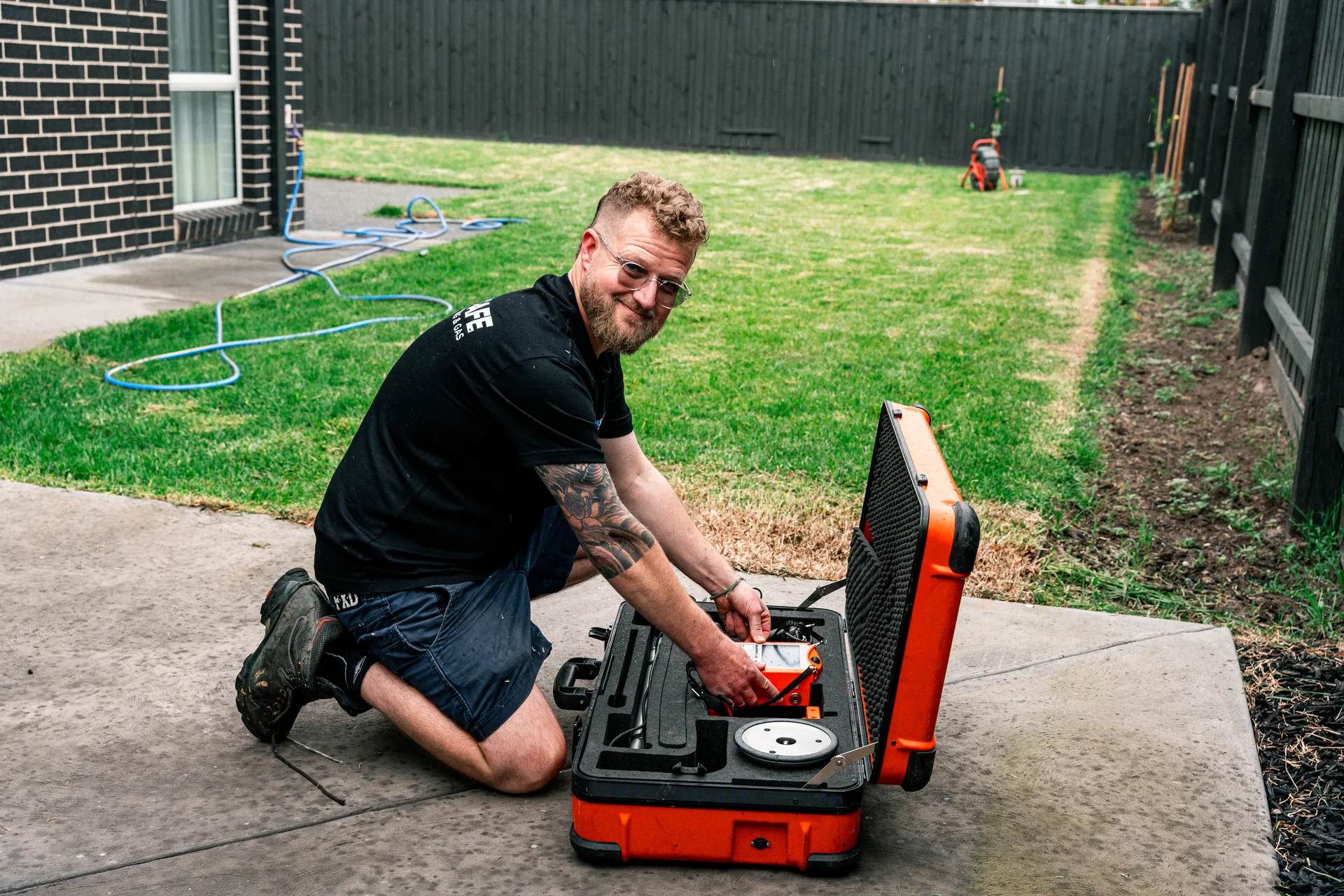
When Gas Experts Melbourne attends a gas leak call, we do not just check with our nose and then apply soap bubbles to visible connections. We use calibrated electronic gas detection equipment that can identify gas concentrations far below the human detection threshold.
Our gas leak investigation process includes a full system gas pressure test (which identifies leaks even where they cannot be seen or smelled), electronic gas detection at all connections and fittings, and a post-repair pressure test to confirm the leak has been fully resolved before we leave.
You receive a written report documenting what was found, what was repaired and the results of the post-repair pressure test.
When to Call Us for a Routine Gas Leak Test (Even Without Symptoms)
You do not need to smell gas to benefit from a gas pressure test. We recommend a professional gas system test in the following situations:
- You have moved into a property and do not know the service history of the gas appliances or pipe work
- Any building or renovation work has been carried out near gas pipes or appliances
- Your gas flexible hoses are more than 10 years old
- Your gas bill has increased unexplainably
- You have an older property with gas pipe work that has never been professionally tested